

As a research group within the Electrical Engineering (EE) Division of the University of Cambridge, the LRDC was proud to contribute to the recent day of celebration – held at the University’s West Cambridge Innovation Campus – marking the 20th and 10th anniversaries, respectively, since the EE Division and the Cambridge Graphene Centre moved to the site, just beyond the city centre.
With the aim of showcasing how Cambridge research is transforming tomorrow’s technologies, the 1-day, landmark conference and exhibition provided a unique occasion for industry leaders, University of Cambridge alumni, academics, researchers and students to make connections, share ideas and explore innovation.
World-class speakers
Prof Andrea Ferrari, Cambridge Graphene Centre, welcomed delegates, after which Dr Herman Hauser of Amadeus Capital gave a talk on ‘Using Science Breakthroughs to Enhance Competitiveness. World-class speakers presenting during the conference included:
- Prof Konstya Novoselov, National University of Singapore, Nobel Prize-winning physicist and co-discoverer of graphene
- Dr Phillip Stanley-Marbell, Founder and CEO, Signaloid
- Dr Giorgia Longobardi, Co-founder and Chief Marketing Officer, Cambridge GaN Devices
- Dr Richard Price, Chief Technology Officer and Co-founder, Pragmatic Semiconductor
Prof Pablo Jarillo-Herrero, MIT, 2026 Kavli Laureate, and pioneering researcher in quantum materials and twistronics - Prof Tawfique Hasan, Professor of Nanomaterials Engineering, University of Cambridge
who shared their perspectives on the translation of research into real-world impact, collaboration across sectors, enterprise and entrepreneurship, and more.
LRDC demonstrates innovative systems
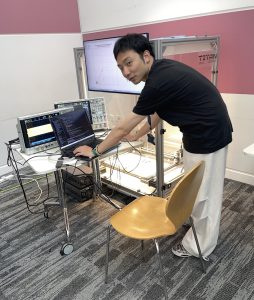
Researchers, Drs Rizwana Ahmad and Sina Babadi, and PhD student Yifan Huang, represented the LRDC at the exhibition accompanying the conference, where they demonstrated two of the novel, optical wireless communications (OWC)-based systems that are being developed and tested within the team.
The TITAN project demonstration presents a real-time, LiFi-based optical wireless positioning system, housed in a compact glass and steel case. By analysing signals received from multiple optical transmitters and applying machine learning-based positioning, the system continuously estimates and displays the location of a moving device with high accuracy. This functionality highlights how existing lighting and optical wireless infrastructure can support both connectivity and precise spatial awareness. Applications that could benefit from this capability include smart manufacturing, robotics, healthcare, warehousing and other environments where reliable indoor positioning is required. Optical positioning also offers advantages including immunity to radio-frequency (RF) interference, spatially confined operation and the potential to integrate communication, positioning and sensing within a common infrastructure.
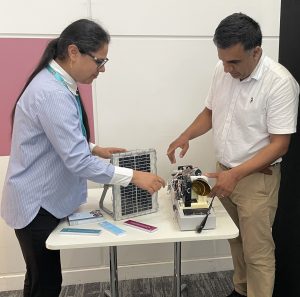
The solar cell demonstration addresses multiple issues associated with transmitting data via RF, such as the increasingly congested radio spectrum, or fibre, which can be costly and time consuming to deploy, with both mediums having relatively high power requirements. Instead the solar cell, or panel harnesses OWC to receive data while simultaneously harvesting energy, offering benefits such as lower power consumption, reduced costs, greater robustness and seamless integration with existing structures. It is also portable, easy to setup and operates high bandwidth with no interference or requirement for spectrum licencing.
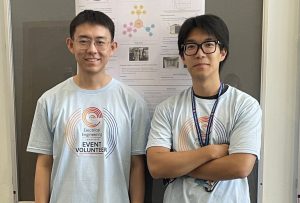
LRDC PhD students Ziheng Wang and Tiankuo Jiao also lent a helping hand for the day, as members of the operations team, ensuring the event ran smoothly for everyone attending.
LRDC reflection on taking part
Dr Iman Tavakkolnia, Associate Professor at the LRDC, said “We were delighted to contribute to this Celebration Day, alongside our colleagues in the Electrical Engineering Division at the West site, and it provided us with a great opportunity to demonstrate some of the pioneering research we are undertaking at the LRDC to a diverse and interested audience.”