

The relentless growth in mobile data traffic, coupled with the diverse requirements of emerging applications, means that current wireless communication systems must evolve if they are to continue to service user demand. In response to this dilemma, a team of researchers from the LRDC turned to 5G technologies, in particular network ‘slicing’, as a way of developing new solutions with the potential to meet future needs of both users and services. This work was funded by the REASON project.
Network slicing divides a single, physical network into ‘slices’, each tailored to specific needs, allowing telecommunications operators to segment and differentiate their services according to, for example, different applications, industries or user groups. Network slices fall into three categories:
- Enhanced mobile broadband (eMBB) – used to support high-speed internet applications such as streaming and gaming
- Ultra-reliable low latency communication (URLLC) – designed for critical applications like industrial automation and autonomous vehicles
- Massive machine-type communication (mMTC) – enables large-scale Internet of Things (IoT) deployment, for instance, smart cities and connected devices.
Concurrently, as wireless networks evolve, initiatives such as the Open Radio Access Network (O‑RAN) are promoting open, interoperable and disaggregated RAN architectures capable of unifying diverse radio technologies, including non‑3GPP systems such as Wi‑Fi and LiFi. The REASON project: Realising Enabling Architectures and Solutions for Open Networks, developed this vision by introducing the multi‑access technology real‑time intelligent controller (mATRIC), a framework to manage and improve heterogeneous access technologies. Within this context, extending network slicing to hybrid Wi‑Fi/LiFi deployments offers a promising option for ensuring that each technology can meet its specific performance requirements while operating as part of a cohesive, multi‑access RAN.
However, although network slicing has distinct advantages in meeting diverse requirements, it also poses particular challenges related to energy consumption and operational costs, raising concerns about the balance between performance and energy efficiency (EE), and consequently overall sustainability.
The work undertaken by the research team to address this scenario contributed to the REASON project’s goal of enabling intelligent, flexible, next‑generation RAN architectures. Through collaboration and experimentation, the researchers created a framework, employing a deep learning model trained with the resilient backpropagation algorithm (RProp), that dynamically determines the appropriate network slice composition for a given user group, based on historical key performance indicators (KPIs). Their approach incorporated a unique, predict-and-optimise algorithm for hybrid Wi-Fi/LiFi networks that adjusts precoding vectors to maximise EE, while meeting slice-specific quality-of-service (QoS) requirements, low latency and operation within power constraints. QoS demand was built in by modelling eMBB, URLLC and mMTC, ensuring realistic reliability and latency treatment.
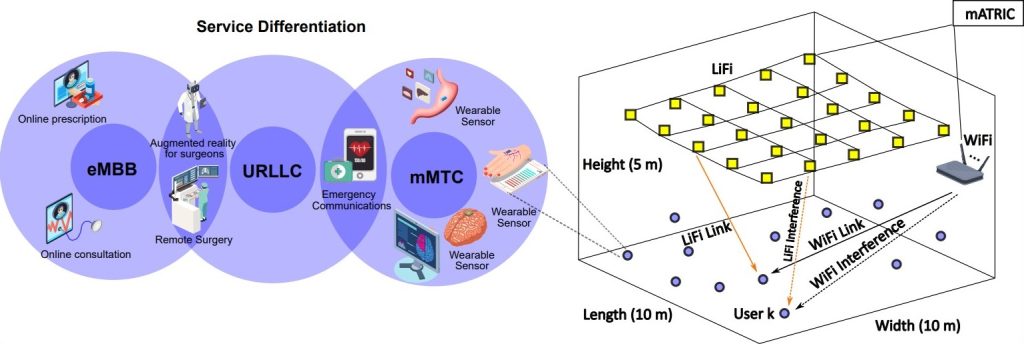
Simulation results demonstrated that the proposed algorithm achieves up to 37% EE improvement over zero-forcing precoding; a multiple-input, multiple-output (MIMO) technique that cancels multi-user interference. It is able to converge within 10–20 iterations to quickly find a stable solution, and exhibits robust scalability with increasing numbers of Wi-Fi/LiFi access points. This performance level validates the algorithm’s effectiveness for next-generation, heterogeneous wireless networks, offering a tangible option for the future.
The work described in this article is presented in the published paper ‘Efficient Service Differentiation and Energy Management in Hybrid WiFi/LiFi Networks, by Asim Ihsan and Hossein Safi, formerly of the LRDC, Muhammad Asif, Tongling University, and Iman Tavakkolnia and Harald Haas of the LRDC. Read the paper in full in IEEE Transactions on Green Communications and Networking.